Natalia Mezhenska, CEO of OTP Capital
“Create blue oceans”. “No, get better in red”. From all possible options, we are offered a binary move: either open a new exclusive market, or compete in existing market with hundreds of other players. Working for over 20 years in the financial sector, which is like an ocean full of predators and periodic storms, I can share one magic hack that helps business at all times – optimization.
Optimization begins with growth
Scale or Fail – literally, scale or die. Is scaling business always worthy? I want to run ahead saying: sometimes no. However, in most business models in the financial market this is the vector of development. OTP Capital is no exception. Every month we watch the funds’ capital growth under our management, monitor the dynamics in returns, and keep our finger on the pulse of what is going on. After all, no one cancelled the butterfly effect.
It is no secret that many companies are developing and expanding their business, including through acquisitions or takeovers of other companies. In 2014, OTP Pension also had such experience joining the former Ukrsotsfond (Ukrsotsbank’s pension fund). Then gained 14 million UAH and 18 thousand participants.
This way of adding a smaller player to a larger one is not new. At a time, many companies were walking along that path. After all, the strategy brings results. We observe this trend even among the world market leaders. Yes, Disney once bought Fox and since then the most famous family in the United States – the Simpsons – began to recall more Disney characters, while their aunts were banned from smoking in the frame. Thanks to the agreement between Facebook, What`s up and Instagram, we now have a multifunctional platform for promotion on social networks with dozens of advanced features. Amazon created new opportunities in the food business by acquiring the Whole Foods Market grocery chain.
Today OTP Pension is one of the largest players in the market of non-governmental pension funds. Frankly speaking, for the last 5 years we have also been actively looking at other participants to join us.
The moment we understand that we want and can expand the first question to ask is “How can we optimize?”
Why costs are important?
It is logical that monitor someone closely, you begin to analyse his/her actions more precise. All with one goal to draw up in the conclusion the correct price offer to the seller of the assets you are interested in.
I will tell no names, but a true story with a clear example of one such pension fund, we were monitoring for several years. Let’s call it “X Fund”. So, let us speak more about the record of our monitoring. We took data for the last 8 years, 2013-2020 inclusive. The yield (net of all costs) for X Fund for this period, according to our estimation, was 21%. The yield of OTP Pension, for example, was 224% for this period. This is how the flow of fund returns looked like for similar period:
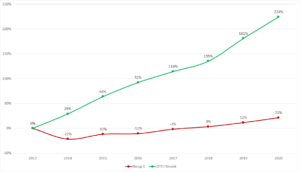
Odd figures, aren’t they? You do not need a degree at Finance to understand that there is a specific serious reason for such a sharp lag in profitability. We began to investigate the reason for such a sharp difference in the performance of the fund monitored and the fund under our management. As you know, one of the main factors that affect the profitability of the fund is its total costs. Therefore, our next move was to get through a weak point of X Fund – its costs.
As it turned out, all 8 years they were close to the legal maximum and were at the point of about 7%. In total, these costs amounted to about 53.3% during this period. You just think! The fund participants made a return of 21%, while the company spent 53.3%, twice as much, on services!
In fact, the fund looked like a sieve: the income generated flowed through huge holes of unreasonable costs. No matter how many times we change our investment strategy or balance the portfolio, the changes will happen no earlier than we will deal with the holes.
Where does optimization begin? It begins at the moment of being honest with yourself: where and what are the holes draining it away and what we get in the end?
Optimization is scaling
Why do I introduce this case with all its details? For our OTP Capital team, cost optimization is one of the most important topics not just in a single case, as with the “sick patient” I mentioned above, but also in the context of all funds under our management. “To cut costs” is not a mantra, but routinely self-repeated collocation. As far back as I can remember myself being a CEO, my persistent negotiations with all contractors were for better conditions.
The principle also works vice versa. After all, we not only use the outsourcing services of other companies (for example, pension fund administration services, asset storage, brokerage, audit), but also provide them ourselves, managing assets.
It would seem that we, as a funding company, are interested in getting the maximum profit from our business, taking the maximum commission for our management services. However, such approach is primitive and short-sighted.
It is possible, that in the short term, you will get decent-like money from the business. However, customers are not simple-minded either and you risk losing their trust in the future, consequently losing the whole business.
In July 01, 2021, we reduced once again our commission for the management of BMF “OTP Pension”. After such a reduction, the total costs of the fund will be within 3%, which is at a level lower than the market average. The plans are not to stop, to continue to increase assets and reduce costs.
How I would reply to third question “why”? Cost optimization is the scaling. Nevertheless, in a different way. Without acquisition though, but due to the growth, when a client noticing you respect him, coming back with a few new ones. If a client feels like a true partner in a business, he will appreciate having it and continue to invest in it.