
At some point in life, each of us faces a simple yet highly relevant question: what will be our source of income in the future, and will the state pension alone be enough?
One way to take care of your financial future is to build up your own pension savings in advance, which may supplement state pension payments in the future. This is what non-state pension funds (NPFs) are designed for.
What is an NPF and how does it work?
The mechanism behind an NPF is quite simple: a participant makes a contribution, which, together with contributions from other participants, forms the fund’s pooled pension assets. These assets are professionally managed and invested in various financial instruments in accordance with the fund’s investment strategy.
At the same time, each participant’s contributions and investment results are accounted for separately in their individual pension account. In other words, pooled asset management does not mean pooled accounting of individual savings.
Thus, an NPF combines professional management of pooled pension assets with individual accounting of each participant’s savings.
The main purpose of an NPF is to help gradually build up personal pension savings that can supplement state pension payments in the future.
Who manages NPF funds?
The funds of a non-state pension fund are not controlled by a single company. Asset management, accounting and safekeeping are divided among different companies — professional market participants.
The NPF administrator maintains individual records of participants, their contributions and pension savings.
The asset management company (AMC) makes investment decisions and manages pension assets in accordance with the fund’s strategy and statutory restrictions.
The custodian bank safekeeps the fund’s assets and monitors transactions involving them.
The activities of NPFs and professional participants in the non-state pension system are regulated and supervised by the National Securities and Stock Market Commission of Ukraine (NSSMC).
The protection of participants’ funds is based on the principle of the separation of responsibilities and mutual oversight: different functions are performed by different participants, and their activities are carried out within a special legal framework.
How is an NPF’s return generated?
An NPF’s return depends on the results of the fund’s investment activities, which are reflected in the value of its pension assets and affect the value of participants’ savings.
Each NPF has a defined investment strategy. The investment strategy determines how the fund manages its pension assets: which instruments it uses, how it allocates funds and what level of risk it takes into account. Therefore, the results of different NPFs may vary.
For example, two funds managed by OTP Capital have different strategies: OTP Pension NPF uses a conservative investment strategy, while FreeFlight NPF follows a currency-based strategy.
An NPF’s return is neither fixed nor guaranteed. It may change depending on the results of investment activities. Therefore, the result for a particular month or year does not indicate in advance what the result will be in the future.
For long-term savings, what matters is not individual short-term fluctuations, but how contributions and investment results build up savings over an extended period.
What determines the amount of future pension savings?
The future amount of pension savings is affected by several factors. The key ones include the savings period, regularity and amount of contributions, as well as the fund’s investment result, i.e. its return.
SAVINGS PERIOD
The earlier you start, the longer your money can accumulate and be invested.
A longer period makes it possible not only to make more contributions, but also to earn investment returns on the savings already accumulated for a longer time.
REGULARITY
Regular contributions help systematically increase your savings.
At the same time, you do not necessarily need to set aside a large amount from the outset. What matters is starting with a comfortable contribution and, where possible, increasing it over time.
CONTRIBUTION AMOUNT
The amount of each contribution directly affects the amount of funds a participant accumulates over the entire period. The larger the contribution, the greater the base you build for your future pension savings.
At the same time, the contribution amount can be adapted to your personal financial situation. When your income increases, you can increase your contribution. If your expenses temporarily increase, you can reduce the contribution or take a break. This allows your savings to adapt to different stages of life without giving up your long-term goal.
INVESTMENT RESULT
NPF participants’ contributions are invested, and the resulting investment return is credited to their pension savings. Over time, investment results may therefore increase the amount accumulated through contributions and affect the final amount of savings. The longer the savings period, the more significant this result may become in building future capital.
How compound interest works: an example based on OTP Pension NPF
Let’s assume that you make a contribution of UAH 2,000 every month for 20 years. Over this period, the total amount of contributions would be UAH 480,000. Assuming an average annual fund return of 14% per annum and the effect of compound interest, such contributions could build up approximately UAH 2.3 million in savings.
Building up savings with an NPF: how contributions and investment results affect the amount of savings over 20 years.
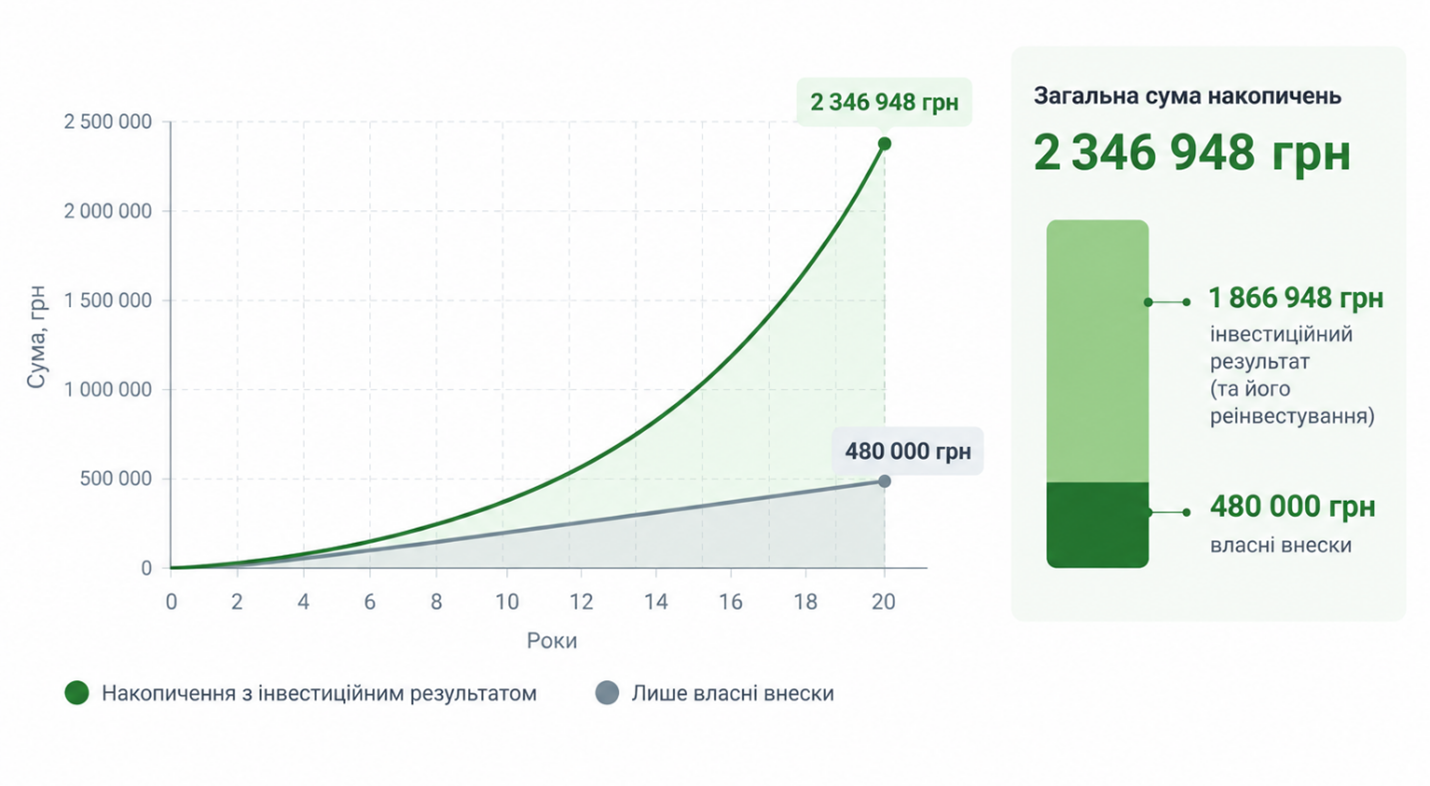
This example illustrates how, over a long savings period, investment results can significantly increase the amount contributed from your own funds. In the calculation above, approximately UAH 1.87 million comes from investment results and their reinvestment.
What happens to the accumulated amount afterwards? Over the following 20 years, the savings are used for payments, while the funds that remain continue to be invested. Therefore, at the beginning of the payment period, the amount of savings in the example continues to grow and then gradually decreases.
NPF pension payments: how the amount of savings changes over 20 years of payments while the funds continue to be invested.
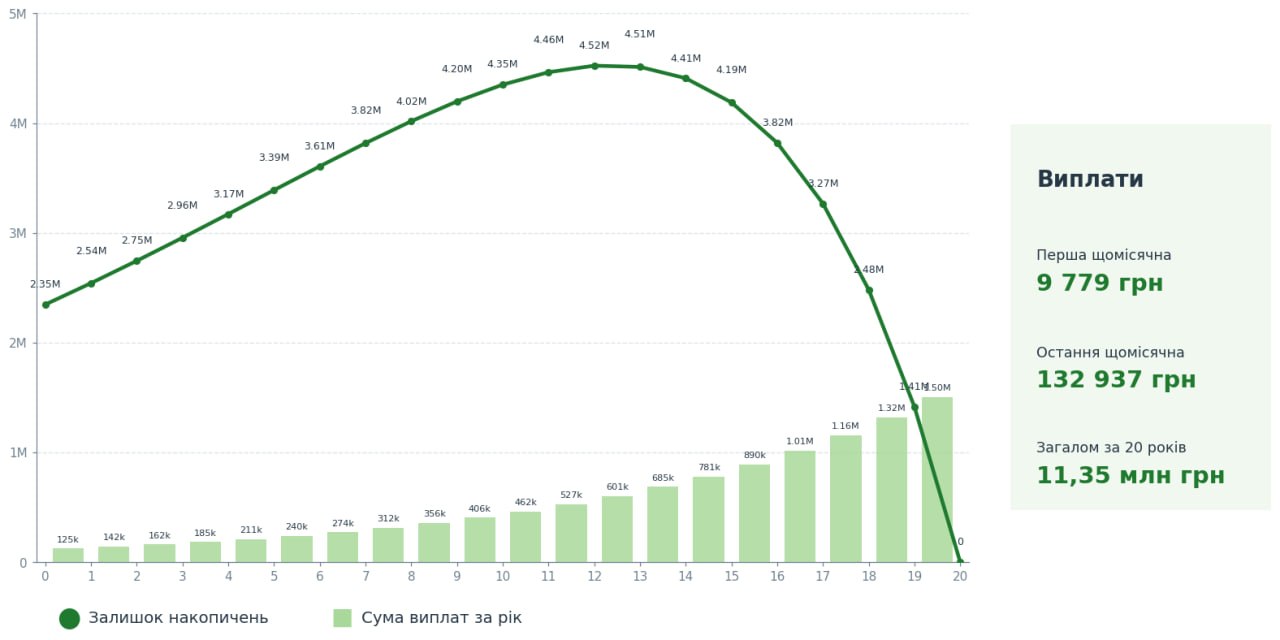
At the beginning of the payment period, the accumulated amount is approximately UAH 2.35 million, while the first monthly payment is UAH 9,779. The remaining funds continue to be invested, so during the first few years the amount of savings continues to grow and, in the calculation above, reaches UAH 4.52 million in the 12th year of payments.
After that, the savings gradually decrease until the payment program is fully completed in the 20th year, when the final monthly payment reaches UAH 132,937. In total, UAH 11.35 million in payments would be made over 20 years.
The calculations above are for illustrative purposes only and do not constitute a forecast or guarantee of future results. The actual amount of savings and payments will depend on actual contributions, the savings period and the results of the fund’s investment activities. Past performance does not guarantee future returns.
Thus, long-term savings depend on a combination of time, regular contributions and investment results. The longer the funds remain invested, the more time they have to accumulate and reinvest the returns generated.
What benefits does an NPF offer?
For a participant, it is important not only to understand how pension assets work, but also what the system offers in practice. An NPF provides several opportunities that make long-term savings more convenient and easier to understand.
Contribution flexibility. The amount and frequency of contributions can be adapted to your own financial capabilities. There is no so-called “mandatory payment” that must be made every month.
Long-term investing. Contributions are not simply accumulated in a pension account — they are invested. The resulting investment return remains part of the savings and may affect their future amount.
Professional management. Pension assets are managed by professional market participants in accordance with the investment strategy and legal requirements. Fund participants do not need to analyse the market or select investment instruments themselves.
Control over your savings. A participant has access to information about the status of their own account and can track how the amount of savings and accrued investment return change. Under the conditions provided by law, a participant may also transfer their pension savings to another NPF.
Tax relief. Subject to the conditions established by law, contributions to a non-state pension fund may qualify for a tax credit and a partial refund of personal income tax paid.
The opportunity to build savings for a loved one. An NPF contract can be concluded not only for yourself, but also for the benefit of another person.
Transparency of information. Participants can see the status of their own savings and check how the fund operates: what its assets are invested in, what its performance has been and how the value of pension savings changes.
How to enter into an NPF contract
An NPF contract can be concluded online via Diia, without visiting an office. The process consists of several simple steps:
- go to the pension contract application page and select a fund;
- specify who the contract is being concluded for — yourself or for the benefit of a loved one;
- complete identification and sign the documents using Diia.Signature;
- make the first contribution.
After entering into the contract, you manage your savings yourself — adding a comfortable amount to your account at a pace that suits you. However, regular contributions can help your capital grow significantly faster.
You can monitor your balance and accrued investment income in your personal account. Information about the NPF’s operations and performance is publicly available on the fund’s website.
Remember: the earlier you start building additional pension savings, the more time they will have to grow.
Read also:
TOP non-state pension funds in Ukraine: how to choose the best NPF for yourself
How to take care of your loved ones’ financial future
Two pension contracts: can you save in both hryvnia and foreign currency at the same time?
Frequently asked questions
Where are NPF funds invested?
Pension assets are invested in accordance with the strategy of the particular fund. These may include, for example, domestic government bonds (DGBs), bank deposits, corporate bonds, ETFs and other financial instruments permitted by law.
Can I have several pension contracts?
Yes. You can save under several pension contracts at the same time — either within one NPF or across different NPFs. This can allow you, for example, to build savings under different strategies or for the benefit of different people.
Do I need to make contributions every month?
No. An NPF does not require a mandatory monthly payment. You decide when and how much to contribute based on your financial capabilities. If your circumstances change, you can reduce the contribution or take a break.
What happens to my savings if I take a break from making contributions?
The savings you have already accumulated remain in your individual pension account. In other words, a break in contributions does not reset what you have already accumulated. The pension assets continue to be invested in accordance with the fund’s strategy.
Can I save with an NPF for another person?
Yes. A pension contract can be concluded not only for yourself but also for the benefit of another person. For example, parents can build pension savings for their child.
When can I receive pension payments from an NPF?
NPF pension payments can be received starting from the age of 50. The legislation provides, in particular, for fixed-term pension payments and a lump-sum pension payment. In cases specified by law, funds may be received early.
Is an NPF’s return guaranteed?
No. The return is not fixed: it depends on the results of the fund’s investment activities. Therefore, the actual result may change over the savings period.
Prepared by OTP Capital experts